We respond to your emergency within 15 min
Track Nuisibles
Free quote

Rodent control

Rats, mice, field mice: we identify entry points, set up secure devices and seal off access for lasting, compliant elimination.

Results guaranteedIntervention within 24–48 hCertibiocide certified
4,9746+ avis clients Google
Available now

Request a free call back

We call you back within 15 minutes about your rats and mice.

No obligation · Call back within 15 min during the day
Thank you! We'll call you back within 15 minutes.

Key takeaways

The brown rat (Rattus norvegicus) and the house mouse (Mus musculus) settle wherever they find food, water and shelter. They contaminate foodstuffs, gnaw through cables and insulation, and can transmit pathogens, including leptospirosis through their urine. Professional rodent control combines a diagnosis of entry points, secured bait stations, trapping and durable sealing of access routes.

Species
Rattus norvegicus, Mus musculus
Health risk
leptospirosis (contact with urine)
Key to the treatment
seal the access points, otherwise recolonisation is certain
Response time
24 to 48 h
Price
from €199
Technician
Certibiocide-certified technician

Rats & mice

Rodent control: lasting, guaranteed eradication

Rodents pose a major health risk: contamination of foodstuffs, transmission of diseases, degradation of electrical cables and a fire hazard. An untreated presence worsens very quickly, as their reproduction is extremely fast.

Track Nuisibles works for private individuals, apartment buildings and businesses. Our technicians draw up a complete rodent-control plan, set up secured bait stations and advise on the sealing work required.

Signs of an infestation

  • Black rice-grain-shaped droppings along the walls
  • Scratching noises at night in partitions, attics or false ceilings
  • Gnawed cables, skirting boards or packaging
  • Greasy marks along regularly used passageways
  • Strong, persistent urine odour
Loft rodent control: locating and treating rodent runs.

Identifying them correctly

The most common rodents

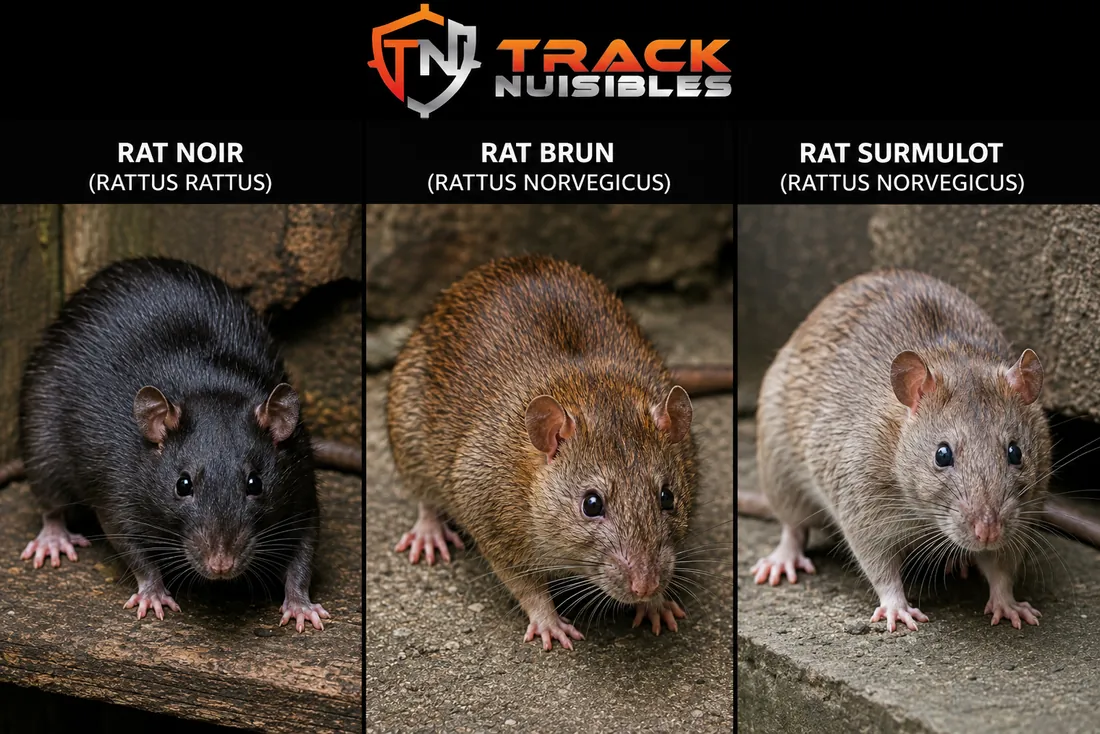
Rats and mice differ in both behaviour and hiding places. Identifying the species means targeting the right runways and the right treatment. If in doubt, send us a photo.

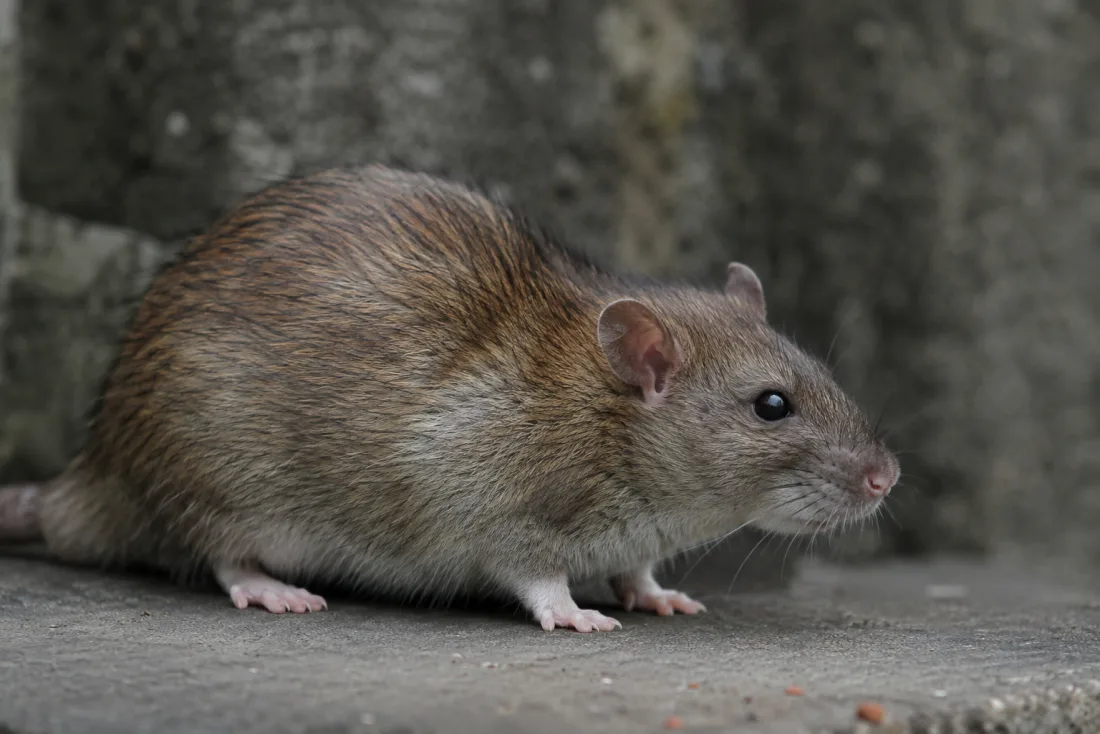
Brown rat (common rat)
The “sewer rat” · the most common

Brown rat (common rat)

Rattus norvegicus

  • Description: The largest of our pest rodents: a stocky body 20 to 27 cm long (excluding the tail), grey-brown coat, rounded muzzle and a tail shorter than the body. It is the most widespread rat in cities as well as in residential suburbs.
  • Lifestyle: A strong swimmer, it lives at ground level: sewers, cellars, basements, refuse chutes, burrows along foundations and around bins. It climbs up through pipes and drainage networks.
  • Reproduction: Sexual maturity at around 8 to 10 weeks, gestation of roughly 3 weeks, 5 to 7 litters per year of 7 to 12 young: a colony explodes within a few months if nothing is done.
  • Signs: Large spindle-shaped droppings, grease marks along the walls, burrows near the foundations, and gnawing on the bottoms of doors and conduits.
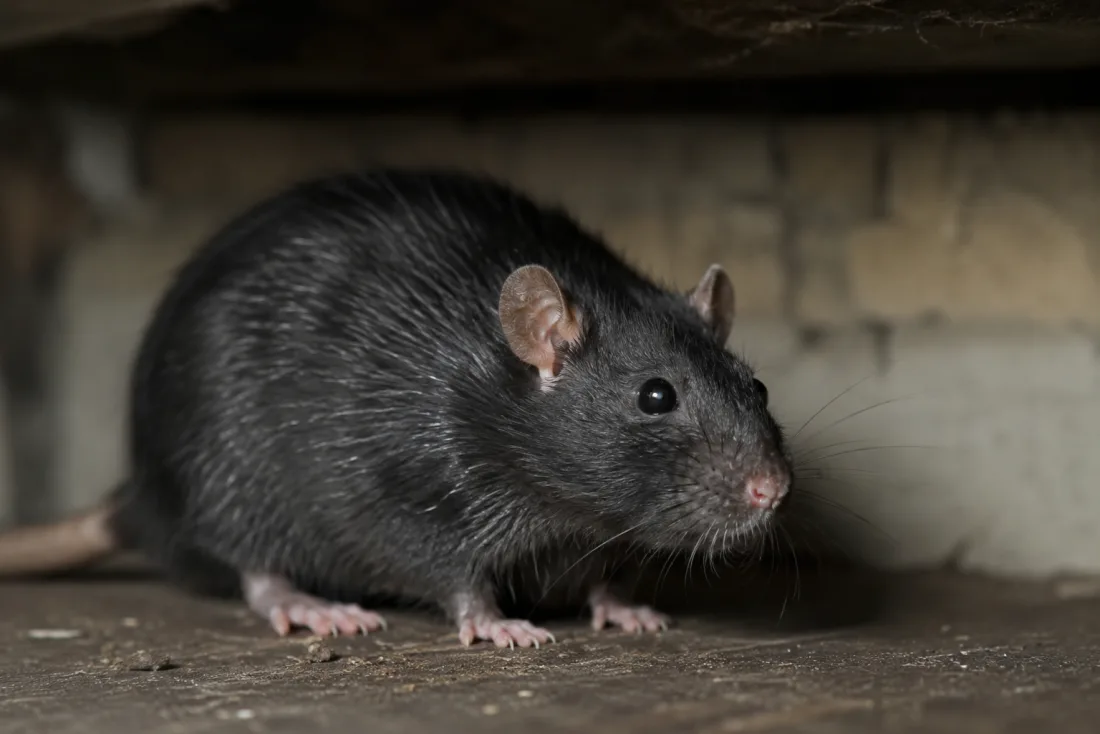
Black rat (roof rat)
Climber · lofts & roofs

Black rat (roof rat)

Rattus rattus

  • Description: Slimmer and lighter than the brown rat, the black rat measures 16 to 24 cm, with large ears, a pointed snout and a tail longer than its body. An excellent climber, it lives up high.
  • Lifestyle: It colonises lofts, false ceilings, roof timbers, attics and trees, and travels along cables, ducts and rooftops. It is often found in apartment blocks and older houses.
  • Reproduction: Maturity at around 10 to 12 weeks, gestation of 3 weeks, 4 to 6 litters per year of 5 to 10 young. Discreet, it often goes unnoticed for a long time before the infestation becomes visible.
  • Signs: Running and scratching noises at night in the loft, droppings up high, gnawed electrical cables (fire risk), and traces along the roof timbers.
House mouse (domestic mouse)
The most discreet · everywhere

House mouse (domestic mouse)

Mus musculus

  • Description: Small rodent, 7 to 10 cm long, with grey-brown fur, a pointed snout and large ears. Its flexible body lets it squeeze through a hole just 6 mm wide — the thickness of a pencil.
  • Lifestyle: It lives as close to people as possible: kitchens, cupboards, wall linings, partitions, behind appliances and in false ceilings. It nibbles small amounts of food constantly.
  • Reproduction: Explosive breeding: maturity as early as 5 to 6 weeks, gestation of 3 weeks, up to 8 litters per year of 5 to 8 young. A single pair can give rise to hundreds of individuals in one year.
  • Signs: Small black rice-grain droppings, a distinctive smell of urine, chewed packets and packaging, and faint scratching noises inside partitions at night.

Our edge

Endoscopic camera detection

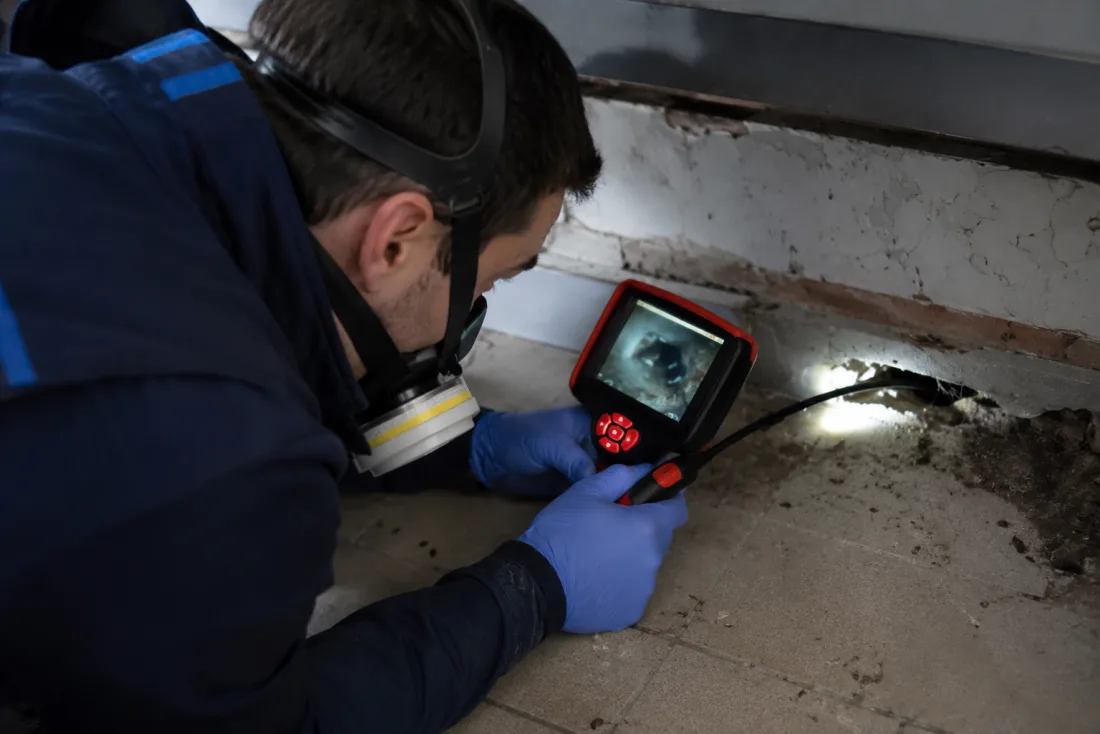
Detection of rodent runways with an endoscopic camera.

Locating the runways

We track rodents down to their hiding spots

Rats and mice move around out of sight: behind partitions, in service ducts, false ceilings, crawl spaces and pipework. Treating without knowing where they travel means treating blind.

Our technicians use an endoscopic camera — a micro-camera mounted on a flexible probe — to inspect these hard-to-reach areas, spot galleries and nests, and identify the true entry points. We then place the devices and seal off access points in the right spot, not at random.

Track Nuisibles technician inspecting a rodent runway with an endoscopic camera
Endoscopic camera inspection: a rodent spotted in its runway, behind a skirting board.

What the inspection reveals

  • Flexible probe inserted into partitions, service ducts and crawl spaces
  • Precise locating of rodent galleries, nests and pathways
  • Inspection of pipes and drainage networks without breaking anything
  • Targeted sealing of the access points actually used, for a lasting result

Correct identification

Rat or mouse: how to tell the difference

The pest determines the protocol: a wary brown rat and a curious mouse are not treated the same way.

CriterionBrown ratHouse mouse
Body size20 to 27 cm (excluding the tail)7 to 10 cm
Weight300 to 500 g20 to 30 g
Droppings1.5 to 2 cm, spindle-shaped3 to 6 mm, rice-grain shaped
Muzzle and earsthick snout, small earspointed snout, large ears
Where it settlescellars, basements, pipespartition walls, attics, furniture
Behaviourneophobic: wary of anything newcurious: explores and tastes quickly
Impact on the treatmentpatient baiting, the stations must be "accepted"trapping and baits: faster results

Our pricing

One or two visits, depending on how long the problem has been present

The number of visits depends on how long the infestation has been present. Caught in time, a single visit is enough; once established, the colony requires a second follow-up visit. Every intervention comes with a free, no-obligation quote.

1 visit

First signs · less than 15 days

From199 €

incl. VAT · flat rate


  • Full inspection + endoscopic camera detection
  • Installation of secure, locked bait stations
  • Sealing off the main entry points
  • Ideal at the first signs, before the colony settles in
Free quote Free advice
The best fit
2 visits

Long-standing presence · more than 15 days

From349 €

incl. VAT · flat rate


  • The entire "1 visit" treatment, reinforced
  • Second inspection and restocking visit
  • Eliminates young rodents born after the 1st treatment
  • Recommended as soon as the infestation exceeds 15 days
Free quote Free advice
One treatment or two: how to choose?

If the first signs appeared less than 15 days ago, a single visit most often eliminates the rodents. Beyond 15 days, the infestation is generally established and young rodents have already been born : a second visit, a few days apart, secures the result by eliminating the entire colony.

Prices are given as a guide. The exact price is confirmed after the inspection, before any treatment. Payment spread over 2 to 12×.

Our method

Rodent control: our 4-step method

1

Camera inspection & detection

Locating nests, runways and entry points — including with an endoscopic camera inside partition walls, service ducts and pipework, where rodents move about out of sight.

2

Secured devices

Installation of locked bait stations, out of reach of children and pets.

3

Sealing of access points

Advice and sealing of entry points to prevent any return.

4

Monitoring & control

Follow-up visits and rebaiting until complete elimination.

Technical sheet

Rats & mice: everything you need to know about the rodent

Intelligent, prolific and active mainly at night, rats and mice slip through the smallest gaps to find warmth, food and shelter. They contaminate food supplies, gnaw through cables and pipes — posing a real health and fire risk — and reproduce so quickly that an untreated presence worsens within a few weeks.

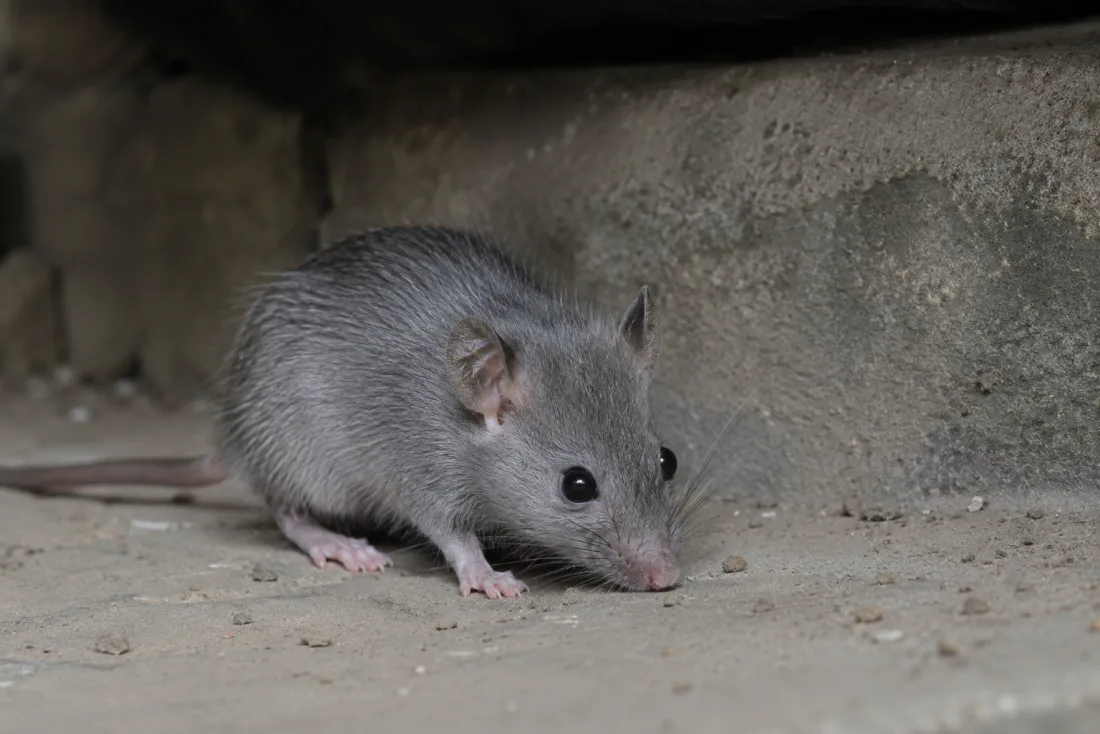
Close-up of a brown rat (common rat)
The brown rat (Rattus norvegicus), the most common rodent in urban settings.

Why you must act quickly

A female can have several litters a year, and her young are themselves fertile within a few weeks : an isolated presence quickly becomes a colony. Rodents gnaw constantly to wear down their incisors — hence chewed electrical cables, punctured pipes and a fire risk.

Our technicians locate the runways (including with an endoscopic camera), install secured devices and seal off access points, with a written results guarantee.

By the numbers

Lightning-fast reproduction

4–8litters per year
5–12young per litter
3 weeksgestation only
≈ 6 mmthe gap a mouse needs

Profile

The rodent in detail

General information

  • Family: Murids (Muridae)
  • Common species: brown rat, black rat, house mouse
  • Type: omnivorous, opportunistic rodent — it eats almost anything
  • Habitat: sewers, cellars, lofts, partition walls, kitchens and the surroundings of buildings
  • Distinctive trait: continuously growing incisors : it gnaws non-stop; the rat is neophobic (wary of anything new)

Lifestyle & development

  • Sexual maturity: 5 to 12 weeks depending on the species
  • Gestation: only about 3 weeks
  • Litters: 4 to 8 litters per year
  • Young: 5 to 12 young per litter
  • Life expectancy: mouse ≈ 1 year, rat ≈ 1 to 2 years

Physical description

  • Size: mouse 7–10 cm · rat 16–27 cm (excluding the tail)
  • Weight: mouse 20–30 g · rat 200–500 g
  • Coat: grey-brown, lighter on the belly
  • Access: a mouse squeezes through a 6 mm hole, a rat through 2 cm

Signs of presence

  • Droppings: black, rice-grain shaped (mouse) or spindle shaped (rat)
  • Sounds: scratching and scurrying at night in walls and lofts
  • Trails: grease marks along walls and repeatedly used pathways
  • Gnawing: cables, skirting boards, packaging and the bottoms of doors chewed
  • Smell: a strong, persistent urine odour near the nests

How they develop

A short, explosive cycle

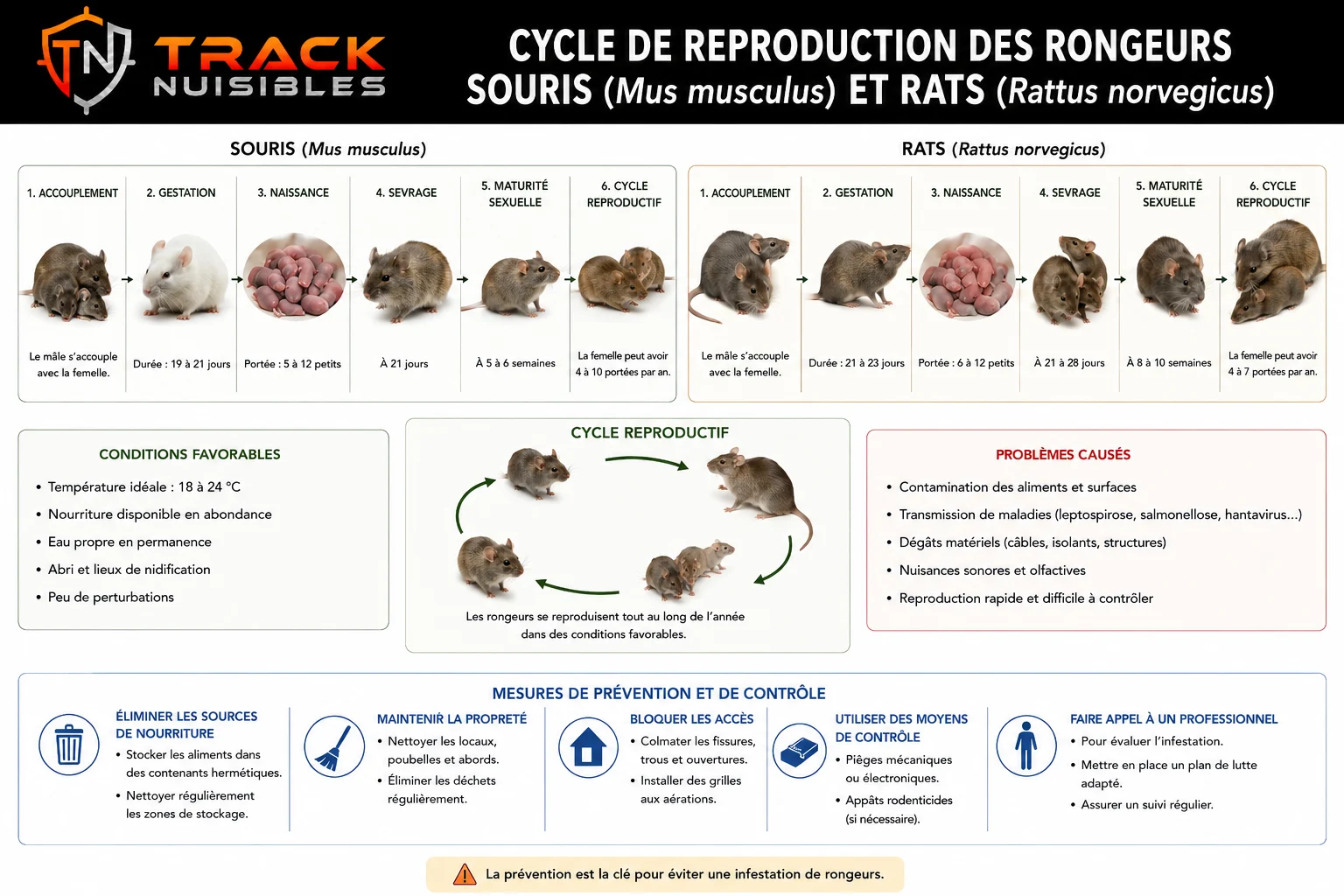
With a gestation period of just three weeks and young that become fertile as early as five to twelve weeks old, rats and mice breed litter after litter without pause. It is this ultra-fast cycle that explains why an infestation older than 15 days calls for a second visit : young rodents, still tucked away during the first treatment, must in turn be eliminated.

Caught in time, however, a recent presence is most often resolved in a single visit — hence the importance of acting at the first signs.

Rodent breeding cycle: mating, gestation, birth, weaning, sexual maturity and reproductive cycle in mice and rats
Mice and rats: a complete cycle in just a few weeks, repeated all year round.

Prevention: reducing everyday risks

  • Seal holes and cracks (steel wool, mortar, fine mesh)
  • Fitting grilles over vents, ducts and drains
  • Keep foodstuffs in airtight containers
  • Take out the bins every day, lid tightly closed
  • Clean up crumbs, grease and food scraps immediately
  • Clear the surroundings: wood, rubble and vegetation against the walls
  • Repair leaks: rodents also seek water
  • Regularly inspect cellars, attics and the back of appliances
Prevention isn't always enough

At the first droppings or noises, only a professional treatment eliminates the colony for good and secures the entry points. Don't wait for the rodents to take over the whole building.

Service areas

Rodent control throughout Île-de-France and on the French Riviera

Four agencies, mobile technicians and short lead times to serve you as close to home as possible.

By department

Rodent control near you

We operate across every department of the Île-de-France region and on the French Riviera. Select yours for your dedicated page.

They trust us

Plus de 746 avis, une note de 4,9/5

4,9
sur 746+ avis Google vérifiés

Excellent experience with Track Nuisibles! Very friendly, punctual and responsive staff. The intervention was fast and effective. Clément was very available, answering every one of my questions. Thank you for your professionalism and kindness. Highly recommend!

ML
Myriam LaouariMalakoff

I got in touch about a bed bug problem. My first contact with Alexandre was welcoming, reassuring and very professional. I got an appointment very quickly, and Clément took the time to explain every step of the treatment. I even received follow-up calls as early as the third day. After a second visit, I no longer have any bed bugs. I recommend this company without a second thought!

SC
Suna CihanGoogle review

Very satisfied with the service. The treatment was fast, the technician punctual and very professional. David took the time to clearly explain each step of the treatment and to answer all my questions, which is truly reassuring in such a stressful situation. The work was done thoroughly and effectively. I recommend without hesitation!

SZ
Sabrina ZaïdGoogle review

I highly recommend this company "Track Nuisibles", very professional and very attentive. Great work, a big thank you to Clément, one of the technicians.

AB
Allegrà BàrbàraGoogle review

I was a little sceptical, but the technician explained everything, showed me with his camera and reassured me. After 10 days, nothing left! On top of the effectiveness, genuine responsiveness: barely 5 minutes between my message and the company's callback, and an appointment booked the same day.

CD
Claudette DomingeGoogle review

Thoroughly satisfied with their intervention. The team is attentive, provides clear and precise information, and takes the time to answer every question. The products used are effective: the problem was solved from the very first visit. A big thank you to Clément for his professionalism and responsiveness. I highly recommend them.

MA
Mina AitomarGoogle review
Happy with our service? Leave us a review:

Payment plans available

Pay in instalments, with complete peace of mind

Because an infestation won't wait, spread your payment over 2 to 12 instalments, to suit your budget.

no fees
no fees
no fees
10× & 12×
low fees

Financing solutions shown for information only, subject to approval. Details provided with the quote.

FAQ

Rodent control — frequently asked questions

How long does it take to get rid of rodents?
Depending on the level of infestation, expect 1 to 3 visits on average. A heavy rodent-control job is subject to regular monitoring.
Are the baits dangerous for my pets?
No: we use secure, locked bait stations that are inaccessible to children and pets.
Do you work with property management companies and businesses?
Yes, we set up rodent-control contracts for property managers, shops, restaurants and industrial sites, with full traceability.
What can I do to prevent rats from coming back?
Sealing entry points and proper waste management are essential. We support you on both fronts.
Is a single visit enough?
If the problem is recent (less than 15 days old), a single visit is usually enough. Beyond that, the infestation is generally established and young rodents have already been born: we then schedule a second follow-up visit to eliminate the entire colony.
How do you locate rodent runs?
We carry out detection using an endoscopic camera: a flexible probe fitted with a micro-camera is inserted into partitions, ducts, crawl spaces and pipes to precisely locate galleries, nests and entry points, without breaking anything.
How do I choose a rodent control company near me?
Three checks before you call. Certification: the technician must hold the French Certibiocide licence to handle rodenticides, and the company must appear on the official business register. Actual distance: a provider more than an hour away bills for travel and puts off the follow-up visit, which is precisely what secures the result. The quote: it must be written, itemised and handed over before any work starts — never given over the phone as a vague “from” price. Track Nuisibles covers Île-de-France from its Alfortville branch (94), the French Riviera from Nice and Cannes, and Occitanie from Toulouse, within 24 to 48 hours.

Sources & references

Our public sources

The health and regulatory information on this page is based on official publications.

Resources

Going further

Our practical guides, detailed answers and our identification tool.

An infestation? Don't wait for it to get worse.

Diagnosis, free quote and fast treatment by certified technicians.

Updated on · Content published by Track Nuisibles, a Certibiocide-certified company (no. N068761)

Call usFree quote WhatsApp